Your phone stays quiet while termites eat through a customer’s house three miles away. That’s the real cost of weak local visibility. Homeowners search for help the moment they spot a bug, and if your business doesn’t show up, they call the next name on the list. I’ve watched this happen to good companies with skilled techs and clean trucks. Great service means nothing if Google can’t find you.
I’ve spent over 20 years in performance marketing, and pest control is one of the most local-intent industries I’ve worked in. People don’t browse pest control the way they shop for shoes. They search because something is crawling on their wall right now. Local SEO for pest control companies solves this by putting your business in front of that exact homeowner, at that exact moment, in their exact city.
This article walks through the real system I use to get pest control brands into the Google Map Pack and keep them there. You’ll learn how Google ranks local results, how to build a Google Business Profile that actually converts, and how to structure location pages without triggering duplicate content flags. Let’s get into it.
Quick Answer
Local SEO for pest control companies means optimizing your Google Business Profile, building location-specific web pages, and collecting keyword-rich reviews so your business ranks in the local Map Pack. This drives qualified leads without ongoing ad spend. Over 60% of clicks in home services go to the top three Map Pack results, making local visibility the single highest-leverage marketing channel for pest control.
Why SEO Matters for the Pest Control Industry
Pest control SEO matters because pest emergencies happen fast and locally. A customer doesn’t wait a week to call about roaches. They search, they scroll, they call whoever shows up first. This is why local search works so differently for pest control than it does for other businesses.
I’ve run campaigns where a single Map Pack ranking outperformed months of paid ads. Ads stop the moment you stop paying. Rankings keep working for you every single day, at no extra cost per click. That’s the math that convinces most pest control business owners to invest here first.
Here’s what makes this channel so strong for the pest control industry: search demand is constant, it’s hyper-local by nature, and the buying decision happens fast. Most homeowners call the first three companies they see and stop looking after that.
Why Pest Control SEO Is Different From Other Local Services
Pest control SEO is different because urgency drives almost every search. A plumber can wait until morning. A termite swarm cannot. This changes how you should structure keywords, content, and even your phone response time.

I’ve noticed something odd working across home service niches. Roofing customers research for weeks. Pest control customers often call within minutes of searching. This means your Google Business Profile and call tracking numbers matter more here than almost any other trade I’ve worked with.
Seasonality also hits pest control harder. Termite swarms spike in spring. Rodents move indoors in fall. Mosquitoes spike in summer heat. Your SEO strategy has to shift with the calendar, not stay static like a roofing or HVAC campaign might.
How Does Google Rank Search Results?
Google ranks search results using relevance, distance, and prominence. These three factors decide who shows up in the Map Pack and who gets buried on page two. Understanding them is the foundation of every tactic in this article.
Local Ranking Factors — Relevance, Distance, Prominence
Relevance means how well your profile matches the search. Distance means how close your business is to the searcher. Prominence means how well-known and trusted your business appears online.
A company with weak reviews but a perfect category match can still lose to a competitor with more citations and better review velocity. This problem happens when business owners fix one factor and ignore the other two. You need all three working together, not just one.
What Is the Local Map Pack (and Why It Matters for Pest Control)
The Local Map Pack is the top three business listings shown on Google Maps results. It sits above the regular organic listings, and it captures over 60% of clicks for searches like “termite treatment near me.”
Customers rarely scroll past it. This problem happens when pest control companies invest only in their website and skip their Google Business Profile entirely. The Map Pack is where pest control leads live, and it deserves your first dollar of SEO budget.
The 3 Pillars We Optimize to Put You in the Map Pack
We optimize three pillars to earn Map Pack rankings: your Google Business Profile, your on-site local relevance, and your off-site authority. These pillars work together, not separately.
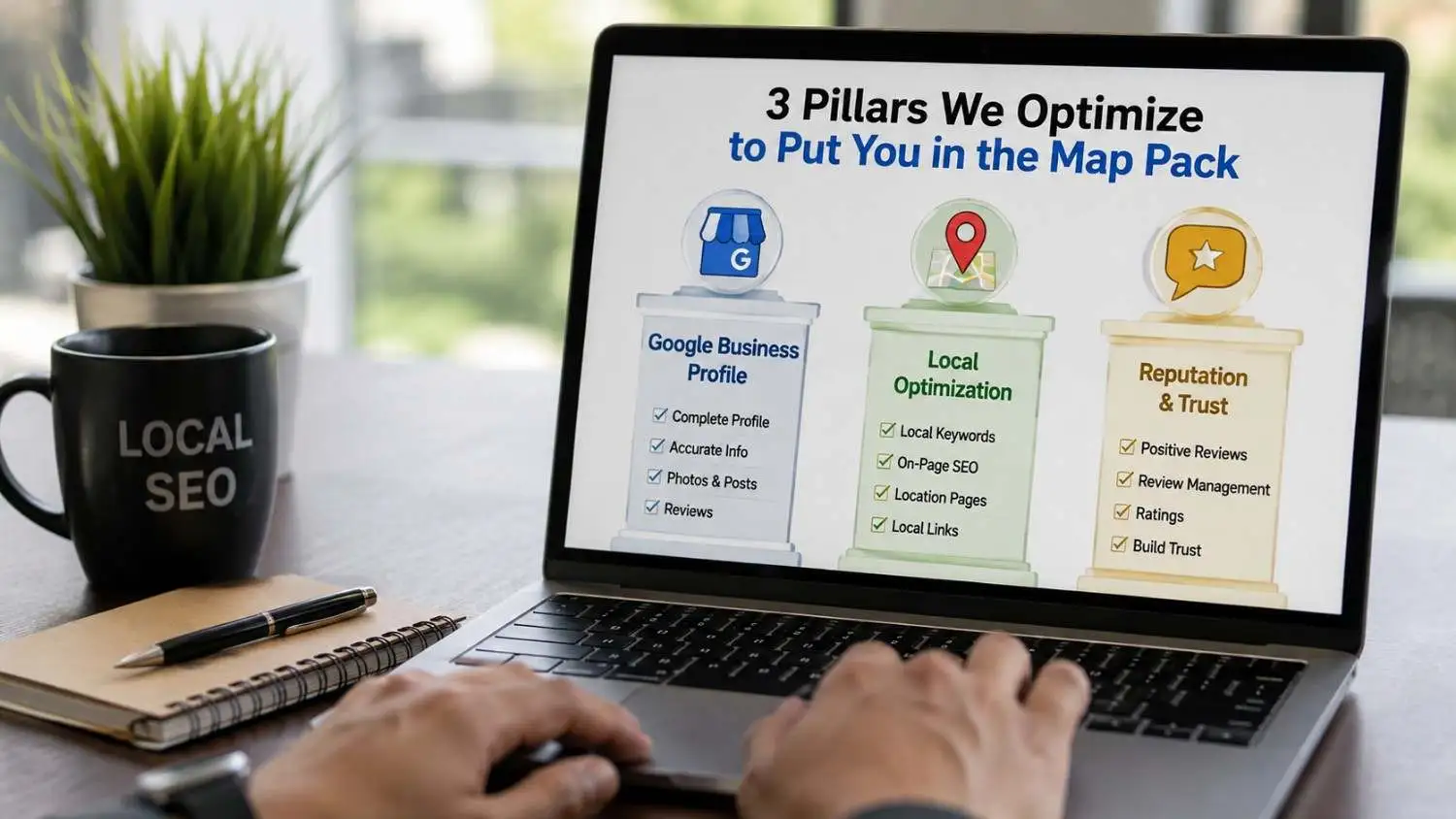
Skip one, and rankings stall no matter how strong the other two are. I’ve seen companies with a beautiful website sit on page two because their GBP profile was half-filled out. I’ve also seen thin websites outrank polished competitors purely because of review velocity and citation consistency. This is why we treat all three as one connected system, not three separate projects.
Optimize Your Google Business Profile
Your Google Business Profile is the single most important local SEO asset you own. It’s free, it’s powerful, and most pest control companies barely touch it past the setup step.
Claim and fill out your profile
Claiming your profile is step one, but filling it out completely is what actually moves rankings. Leave a field blank, and you’re handing an advantage to a competitor who filled theirs in.
Add your service hours, phone number, website link, and business description in full. Customers and Google both use this data to decide if you’re a real, active business.
Add photos
Photos build trust before a customer ever calls you. Upload real images of your trucks, your team in uniform, and jobs completed in the field.
Stock photos hurt more than they help. Customers can tell the difference, and so can Google’s ranking systems.
Collect reviews
Reviews are one of the strongest local ranking signals you can control. Businesses with more recent, keyword-rich reviews consistently outrank quiet competitors.
I train field techs to ask for reviews right after a job, not days later. The response rate drops fast once the truck leaves the driveway.
Primary Category
Your primary category should always be “Pest Control Service,” nothing else. This single setting carries more ranking weight than most owners realize.
Mixing this up, or picking a broader category to “cover more ground,” backfires almost every time. I’ve fixed this exact mistake and watched Map Pack rankings recover within weeks.
Secondary Categories
Secondary categories add specific services without diluting your primary listing. Add “Termite Control Service” or “Wildlife Control Service” here, not as your main category.
This tells Google exactly what else you do, without confusing your core identity as a pest control business.
Visual Trust
Visual trust comes from geotagged, real-world photos that prove you actually work in the area. Branded trucks, uniformed techs, and safety gear photos all count.
This gives Google hard metadata about your service footprint. It’s not decoration. It’s ranking fuel.
Google Posts
Google Posts work like a live feed attached to your profile. Publish seasonal pest warnings, like rodent entry in fall or termite swarms in spring, with a direct “Call Now” button.
Customers searching during an active pest problem convert fast when they see timely, relevant content sitting right on your listing.
Set Accurate Service Areas for [City] and Surrounding Towns
Your service area settings tell Google exactly where you’re willing to send a truck. Set this too broad, and you’ll rank weakly everywhere instead of strongly nearby.
List your core city plus the specific surrounding towns you actually service. Vague or overreaching service areas confuse the algorithm and the customer both.
Use the Q&A Section to Pre-Answer Local Pest Concerns
The Q&A section lets you answer common local pest questions before a customer even calls. Post questions like “Do you treat fire ants in this area?” and answer them yourself.
This builds trust and captures long-tail search intent directly inside your Google listing.
Target Local Keywords and Pages
Targeting local keywords means matching real search phrases homeowners use, not generic industry terms. Broad keywords like “pest control” pull unqualified traffic and cost more to rank for.
Use location keywords
Location keywords combine a specific pest with a specific place. Think “bed bug exterminator in [City]” instead of just “bed bug exterminator.”
This narrows your competition and matches exactly what a local, ready-to-book customer types into Google.
Build location pages
Location pages are dedicated web pages built for each city or service area you cover. One homepage cannot rank across ten different towns.
Each page needs its own content, its own reviews, and its own local details. Customers notice generic pages fast, and so does Google.
Answer homeowner questions
Answering homeowner questions directly on your site captures searches before the panic call happens. Cover topics like signs of termite damage or how to tell bed bugs from fleas.
This positions your site as the trusted local answer, not just another company selling a service.
Urgent Solutions
Urgent solution content targets customers who need help today, not next week. Pages built around “emergency wasp nest removal” or “same-day rodent control” capture this high-intent traffic.
These searchers convert fast. A missing urgent-intent page is a missed phone call, plain and simple.
Long-Tail Niches
Long-tail niche keywords target very specific pest problems most competitors ignore. Phrases like “carpenter ant treatment for older homes” pull in fewer searches but far higher intent.
I’ve seen small pest control companies outrank national brands purely by owning these overlooked niches.
Unique Tex
Unique text on every page prevents Google from flagging your site as duplicate content. Copy-pasting one page across ten cities and swapping the city name is a common mistake that tanks rankings fast.
Write real, specific content for each location. It takes more effort, but it’s the difference between ranking and disappearing.
Meta Tags
Meta tags are the title and description Google shows in search results. They should include your target keyword and your city, written to make a homeowner want to click.
A weak meta tag gets skipped even if your page ranks well. This is free real estate most companies waste.
Seasonal & Pest-Specific Keyword Targeting (e.g., “termite control in [City] this spring”)
Seasonal keywords match pest activity to the time of year customers are actually searching. Termite swarms spike in spring, rodents move indoors in fall, and mosquitoes peak in summer.
Build content around these shifts ahead of time. Waiting until the season starts means you’re already behind competitors who planned early.
Improve Local Authority and Website
Improving local authority means proving to Google that your business is legitimate, consistent, and trusted across the web. This goes beyond your website into directories, citations, and technical performance.
Get local links
Local links from other trusted local businesses and organizations boost your authority fast. Chambers of commerce, local news sites, and community sponsorships all count.
These links tell Google you’re a real, active part of the local business community, not just a website.
Fix mobile speed
Mobile speed matters because most pest emergency searches happen on a phone, not a desktop. A slow-loading site loses the customer before they even see your services.
I’ve watched fast-loading competitor sites out-convert slower, better-designed ones purely on speed alone.
Keep NAP consistent
NAP consistency means your business name, address, and phone number match exactly everywhere online. Even a small difference, like “St.” versus “Street,” can confuse Google’s trust signals.
Check your website, GBP, Yelp, Angi, and every directory listing. Small mismatches quietly damage rankings over time.
Frictionless Scheduling
Frictionless scheduling means a customer can book without calling if they don’t want to. Add an online booking tool directly on your site and your GBP profile.
Some homeowners avoid phone calls entirely. Losing that customer over a missing booking button is an easy fix with a big payoff.
Build Citations on Local & Pest-Industry Directories
Citations are mentions of your business name, address, and phone number on other websites. List your business on pest-industry directories, not just general ones like Yelp.
More consistent citations across relevant directories build the prominence signal Google uses to rank local businesses.
Add LocalBusiness Schema Markup
LocalBusiness schema is code added to your website that tells search engines exactly who you are. It states your business type, exact location, and operating hours in a format Google reads instantly.
This isn’t visible to customers, but it’s a strong trust signal search engines rely on heavily.
Scaling Geographic Landing Pages Across Service Areas
Scaling geographic landing pages means building a structured system of city pages instead of random one-offs. This matters most for companies covering a wide metro area or multiple suburbs.
Page Template for Each Service Area (Suburb/County/ZIP)
A strong page template includes local landmarks, local pest trends, license numbers, and city-specific reviews. Every page should follow this structure while staying unique in the actual writing.
I build these pages branching from the homepage, each covering sub-services and local proof points specific to that city.
Avoiding Duplicate Content Across Location Pages
Avoiding duplicate content means writing real, distinct copy for every single location page. Swapping only the city name across identical pages is one of the fastest ways to get flagged.
Customers can tell too. Generic pages read like templates, and templates don’t build trust with a homeowner deciding who to call.
Multi-Location & Franchise Pest Control SEO
Multi-location pest control SEO requires managing separate listings and pages for every branch without creating conflicts. This gets complicated fast once you cross three or more service areas.

Managing GBP Listings for Multiple Branches
Each branch needs its own separate Google Business Profile, tied to its own real address. Sharing one profile across multiple cities confuses Google and often triggers suspensions.
I’ve fixed accounts where franchise owners built one listing for five branches. It never ends well.
Standardizing Business Info Across Every Branch Listing
Standardizing your business info means every branch uses the exact same name format and consistent listing style. Small formatting differences between branches weaken the overall brand’s local trust signals.
Build a simple internal checklist every new branch follows before launch. It saves cleanup work later.
Voice Search & “Near Me” Optimization for Pest Control
Voice search optimization means writing content the way people actually speak, not the way they type. Someone asking Alexa “who removes termites near me” phrases it very differently than a typed search.
Customers struggle with typing on the fly during a pest emergency, so voice search use is climbing fast in this industry. Focus your content around natural, conversational questions, and make sure your Google Business Profile stays fully accurate, since voice assistants pull answers directly from it.
Cite Authoritative Sources to Build Content Trust (EPA, NPMA, University Extension Studies)
Citing authoritative sources builds trust by backing your claims with recognized experts, not just your own opinion. Reference the EPA for pesticide safety guidelines, the NPMA for industry standards, and university extension studies for regional pest data.
This shows Google and your customers that your content is grounded in real research. I’ve seen thin, opinion-only pest content lose rankings to competitors who simply linked out to credible, well-known sources.
Building a Pest Control SEO Strategy That Actually Works
A pest control SEO strategy that works combines Google Business Profile optimization, local content, and consistent authority building over time. No single tactic carries the whole campaign alone.
The companies I’ve seen succeed treat this as an ongoing system, not a one-time project. They review rankings monthly, adjust for seasonal pest trends, and keep adding fresh local content. The companies that struggle usually built a website once, filed their GBP away, and expected rankings to hold forever. They don’t. Google rewards businesses that stay active.
Track Your SEO Campaign and Measure Results
Tracking your SEO campaign means watching the numbers that actually connect to booked jobs, not just traffic. Rankings mean nothing if they don’t turn into calls.
Key KPIs to Track — Calls, Bookings, Map Pack Position
The KPIs that matter most are phone calls, booked jobs, and your Map Pack position for target keywords. Traffic numbers alone can mislead you if visitors never convert.
Watch these monthly, and compare them against seasonal pest activity so you’re not misreading normal dips as failures.
Using Call Tracking Numbers by Service Area
Call tracking numbers show exactly which service area, page, or campaign generated each phone call. Without this, you’re guessing which location pages actually work.
I set these up per city page whenever a client covers more than two service areas. It removes the guesswork entirely.
Integrate & Automate for Maximum ROI
Integrating and automating your systems connects your GBP, website forms, and CRM so no lead falls through the cracks. Manual lead tracking wastes time and loses jobs.
Automating review requests, appointment confirmations, and follow-up texts frees up your office staff for actual customer conversations. This is where the hidden cost of manual processes really shows up. I’ve audited pest control businesses losing dozens of leads a month simply because no one followed up fast enough.
Common SEO Mistakes to Avoid
The most common SEO mistake is filling out a Google Business Profile once and never touching it again. Local SEO isn’t a set-it-and-forget-it project.

Other frequent mistakes include copy-pasting location page content, picking the wrong primary category, ignoring mobile speed, and letting NAP details drift out of sync across directories. Each one quietly costs rankings, and most business owners don’t notice until a competitor passes them in the Map Pack.
Social Media Promotion for Pest Control
Social media promotion supports your SEO by driving branded searches and reinforcing local trust signals. It won’t replace local SEO, but it strengthens it.
Post seasonal pest warnings, before-and-after job photos, and quick educational tips. Customers who see your brand on social media are more likely to click your listing when they search later.
Benefits of Using PestPac for Your Pest Control Business
PestPac helps pest control businesses manage scheduling, routing, and customer records in one system. A well-organized backend makes it easier to deliver fast, consistent service that earns strong reviews.
Faster response times and organized customer data feed directly into the review velocity your local SEO depends on. Operations and marketing aren’t separate here. They work together.
How to Choose a Pest Control SEO Partner (Or Do It Yourself)
Choosing a pest control SEO partner comes down to proven local experience, transparent reporting, and real results in your specific industry. Generic marketing agencies often miss the urgency-driven nature of pest control search behavior.
If you’re doing it yourself, expect a real time investment. Managing GBP updates, location pages, citations, and reviews consistently takes hours each week most owners don’t have to spare.
Frequently Asked Questions
How long does pest control SEO take to show results?
Most businesses see initial movement within 60 to 90 days, with stronger results by month six.
Do I need a location page for every town I service?
Yes, if you want to rank in each town’s Map Pack results individually.
Is local SEO better than paid ads for pest control?
Local SEO delivers lasting, compounding results, while ads stop the moment spending stops.
How many reviews do I need to rank well?
There’s no fixed number, but recency and keyword relevance matter more than raw count.
Can SEO replace paid advertising?
The company can use SEO alongside paid advertising for stronger lead coverage.
Customers search through many channels before choosing a provider.
This makes combined digital marketing strategies more useful than one channel.
Key Takeaways
- Optimize your Google Business Profile first — it’s the foundation of Map Pack rankings.
- Build unique, city-specific location pages to avoid duplicate content penalties.
- Collect reviews with specific pest keywords to boost local relevance signals.
- Keep NAP details identical across your website, GBP, and every directory.
- Track calls and bookings, not just traffic, to measure real SEO performance.
Closing Thoughts
Local SEO isn’t a one-time fix for pest control companies. It’s a system built on a strong Google Business Profile, real location pages, consistent citations, and reviews that speak the customer’s language. Every piece connects to the next, and skipping one weakens the whole structure. The businesses that stay visible are the ones that keep showing up, season after season, town after town.
We built Top7seven around exactly this kind of work, helping pest control companies across the United States turn local search into a steady stream of qualified leads. If you’re ready to stop losing calls to competitors who simply show up first, we’d like to help you build that visibility. Let’s talk about what your local SEO strategy could look like.