A locked door does not wait for business hours, and neither should your ads. Every hour your Google Ads for Locksmith Leads campaign sits idle, a homeowner across town is searching for someone else. Customers struggle with slow, generic locksmith ads that miss the moment they need help most. That missed moment is a booked job for your competitor instead of you.
I have spent 20+ years building performance marketing campaigns for local service businesses, and locksmiths are some of the toughest to get right. This trade lives on urgency. The system works by matching real search intent, tight geographic targeting, and call tracking to real jobs, not just clicks. I have watched shops double their booked calls simply by fixing campaign structure and killing wasted spend.
In this guide, you will learn how to build locksmith Google Ads campaigns that separate emergency, automotive, residential, and commercial demand. You will learn which keywords convert, which ones drain your budget, and how to track leads all the way to booked revenue. This is field-tested strategy, not theory.
Quick Answer
Google Ads for Locksmith Leads works best with separate campaigns for emergency, automotive, residential, and commercial services, tight local radius targeting, and Call-Only ads for mobile users. Focus budget on high-intent keywords like “emergency locksmith near me” and “car key replacement.” Track every call, not just clicks, and route budget toward booked jobs, not raw leads.
Locksmith Google Ads Campaign Strategy
A strong locksmith campaign strategy separates urgent jobs from planned jobs. Customers locked out of their car do not search the same way as someone planning a lock upgrade. Mixing these two intents in one campaign wastes money fast.
This problem happens when shops run one giant campaign for everything. The system cannot tell Google which clicks matter most. You can solve this by splitting campaigns by service type, then layering in location and schedule controls. This gives you control over spend, bids, and messaging for each customer type.
Emergency Locksmith Campaigns
Emergency campaigns target people locked out right now. These customers need help within minutes, not days. They search on phones, often while standing outside a locked door.
Bid aggressively here. This is your highest-value traffic. Use ad copy that promises fast arrival and live phone answering.
Automotive Locksmith Campaigns
Automotive campaigns target lost keys, lockouts, and key fob problems. Car key issues cost more to fix than house lockouts. This means higher lead value and higher allowable bids.
Customers searching “lost ignition key” or “mobile auto locksmith” need a truck dispatched, not a walk-in shop. Your ads should mention mobile service directly. This matches what the searcher actually wants.
Residential Locksmith Campaigns
Residential campaigns cover rekeying, lock changes, and smart lock installs. These searches happen with less urgency than lockouts. Customers often compare a few companies first.
You can solve this by using ad copy that highlights price transparency and licensing. Residential customers care about trust more than speed. This is a slower buying decision than an emergency call.
Commercial Locksmith Campaigns
Commercial campaigns target businesses needing access control or master key systems. These jobs pay more but close slower. Decision makers often need quotes before booking.
This problem happens when shops treat commercial leads like emergency leads. They are not the same. Commercial buyers want a callback and a quote, not instant dispatch. Build separate landing pages that speak to business owners and property managers.
Emergency vs Planned Search Intent
Emergency intent means “now,” and planned intent means “soon.” The searcher typing “24 hour lockout service” needs help immediately. The searcher typing “change door locks” is planning ahead.
| Search Intent | Example Keyword | Bid Priority |
| Emergency | emergency locksmith near me | Highest |
| Planned | rekey locks cost | Medium |
| Research | how much does a locksmith charge | Low |
Treat these groups differently in bidding, ad copy, and landing pages. Mixing them kills your conversion rate.
Call Focused Campaigns for Emergency Leads
Call-Only Ads work best for mobile users locked out right now. These customers do not want to browse a website. They want to tap and talk to a human.
The system works by skipping the landing page entirely for urgent searches. This shortens the path from search to booked job. For locksmiths, this single change often lifts conversion rates fast.
Geographic Targeting by Service Area
Geographic targeting keeps your ads inside the area you actually serve. This problem happens when shops target an entire metro area with no limits. You end up paying for clicks from customers you cannot reach.
You can solve this by locking your service radius to real drive-time zones. Set your radius by minutes from your shop or dispatch hub, not just miles. This prevents wasted spend and complaint calls from outside your zone.
City and ZIP Code Targeting
City and ZIP code targeting lets you control spend block by block. Some ZIP codes convert better than others, even in the same city. This is something you only learn from real campaign data over time.
Start broad across your service area. Then narrow bids toward ZIP codes with strong call and booking rates. Cut spend from ZIP codes producing few qualified calls.
Ad Scheduling and After Hours Coverage
Ad scheduling controls when your locksmith ads run. Run twenty four seven only if you have live dispatchers answering night calls. Otherwise, match your ad schedule to real business hours.
Customers struggle with locksmiths who advertise 24-hour service but do not answer at 2 a.m. That mismatch destroys trust and wastes ad spend. Turn ads off during hours nobody answers the phone.
Locksmith Google Ads Campaign Setup
Campaign setup determines whether your budget reaches real customers. Small setting mistakes cause big budget leaks. Getting this right from day one saves months of wasted spend.
This section covers the technical settings that shape every campaign above. Skip these steps, and even great keywords will underperform.
Search Campaign Settings
Search campaign settings control where and how your ads show. Choose Search Network only for locksmith campaigns in most cases. Display Network traffic rarely converts into booked locksmith jobs.
Set your campaign to “Search Partners off” if lead quality matters more than volume. This keeps your traffic tighter and more predictable.
Service Area and Location Options
Service area settings decide which searchers see your ads. Choose “people in your targeted locations” instead of “people who show interest.” This keeps ads focused on your real coverage zone.
The company should avoid the default “presence or interest” setting. That setting shows ads to people researching your area from elsewhere. It wastes budget on clicks that never turn into local jobs.
Budget Allocation by Locksmith Service
Budget allocation should follow job value, not just search volume. Emergency and automotive jobs pay more per call than most residential work. Put more daily budget behind your highest-value campaigns.
A simple starting split looks like this:
- Emergency lockout: 35% of budget
- Automotive key services: 30% of budget
- Residential services: 20% of budget
- Commercial services: 15% of budget
Adjust this monthly based on real cost per booked job, not guesses.
Search Network and Partner Settings
Search Network settings decide which partner sites can show your ads. This problem happens when shops leave partner networks turned on by default. Traffic quality often drops on these extra placements.
You can solve this by testing partner traffic separately from core Google search. Turn it off if conversion rates lag behind your main search traffic.
Google Ads Campaign Types for Locksmith Leads
Different campaign types serve different stages of the customer’s search. Search Ads catch active demand. Performance Max and Remarketing catch people who are close but not ready yet.
Using the right mix lets you cover more of the buying journey. Relying on Search Ads alone leaves opportunity on the table.

Google Search Ads
Search Ads target people actively typing locksmith search terms. This is your core traffic source and where most budget should live. Search Ads capture the highest intent, especially for emergency terms.
Performance Max Campaigns
Performance Max campaigns use automation to find leads across Google’s networks. This includes YouTube, Display, Discover, and Search combined. It can extend reach beyond what standard Search Ads capture alone.
Performance Max works best as a supplement, not a replacement, for locksmith Search Ads. Emergency intent still converts best on plain Search campaigns.
Remarketing Campaigns
Remarketing campaigns re-target people who visited your site but did not call. Customers struggle with comparison shopping between two or three locksmiths before deciding. Remarketing keeps your brand visible during that decision window.
This works well for residential and commercial services with longer decision timelines. It works less well for true emergencies, since those customers need help immediately.
Search vs Performance Max
Search Ads win for urgent, high-intent locksmith searches. Performance Max wins for broader reach and planned services. Use Search first, then layer in Performance Max once your Search campaigns run efficiently.
High Intent Locksmith Keyword Strategy
High-intent keywords match exactly what a stressed customer types. The right keyword list separates ready-to-book customers from casual researchers. Getting this list wrong is the single biggest reason locksmith campaigns waste money.
Build separate keyword lists for each service category. This keeps ad copy and bids aligned with real customer intent.
Emergency Locksmith Keywords
Emergency keywords capture customers locked out right now. Strong examples include emergency locksmith near me, twenty four hour lockout service, and open house door now. These searches convert fast and deserve your highest bids.
Automotive Locksmith Keywords
Automotive keywords capture lost keys and car lockout searches. Strong examples include car key replacement, lost ignition key, and mobile auto locksmith. These customers often need a truck dispatched to a parking lot or driveway.
Residential Locksmith Keywords
Residential keywords capture home lock and security searches. Strong examples include rekey locks cost, smart lock installation, and change door locks. These searchers often compare pricing before calling.
Commercial Locksmith Keywords
Commercial keywords capture business access and security searches. Property managers and business owners search for master key systems, access control, and commercial rekeying services. These leads take longer to close but pay more per job.
Near Me and Local Locksmith Keywords
“Near me” keywords carry strong local intent and location-optimized value. Customers typing “locksmith near me” want the closest available help. Google already understands location, but your ad copy should reinforce it with your city or ZIP code.
Negative Keywords
Negative keywords block searches that waste your budget. This problem happens when broad match keywords pull in unrelated traffic. Add exclusions like jobs, school, DIY, how to, home depot, and lockpick set right away.
Customers searching “locksmith jobs near me” want employment, not service. Customers searching “how to pick a lock” want a tutorial, not a bill. Block these terms before they drain your budget.
Locksmith Keyword Match Types and Search Intent
Match types control how closely a search must match your keyword. This choice directly affects lead quality and wasted spend. Getting match types wrong is one of the most common locksmith PPC campaign setup mistakes.
Each match type serves a different purpose in a well-built account.

Exact Match Keywords
Exact match shows ads only for very close variations of your keyword. This gives you the tightest control over spend. Use exact match for your highest-value emergency and automotive terms.
Phrase Match Keywords
Phrase match shows ads for searches containing your phrase in order. This balances reach with relevance. It works well for mid-funnel terms like “rekey locks cost.”
Broad Match Keywords
Broad match shows ads for loosely related searches, based on Google’s interpretation. This problem happens when broad match runs unchecked on a locksmith account. Locksmith broad match problems often mean irrelevant clicks and wasted budget.
Customers struggle with locksmith irrelevant clicks when broad match pulls in searches like “locksmith training courses.” Use broad match carefully, and only with strong negative keyword lists in place.
Search Intent Segmentation
Search intent segmentation groups keywords by what the customer actually wants. Separate emergency, planned, and research-stage searches into different ad groups. This keeps your messaging matched to the customer’s real urgency level.
Search Term Analysis
Search term reports show the exact words that triggered your ad. Review this weekly for any active locksmith campaign. This is how you catch locksmith search terms wasting money before they add up.
You can solve this by adding new negative keywords every week based on real search data. Small weekly cleanups prevent large monthly losses.
Locksmith Bid and Budget Strategy
Bid strategy should follow which keywords produce booked jobs, not just clicks. This section covers how to prioritize spend across services, times, and locations.
Smart bidding decisions come from data, not guesses about what should work.
Emergency Keyword Bid Prioritization
Emergency keywords deserve your highest bids in almost every locksmith account. These searches convert fastest and pay the most per job. Underbidding here means losing the most valuable calls to competitors.
Service Specific Bid Strategy
Bids should reflect the real value of each locksmith service. Automotive and emergency work typically pays more than basic residential lock changes. Set higher target bids for services with higher average job value.
City and ZIP Code Bid Strategy
Bid adjustments by ZIP code let you spend more where jobs actually book. This problem happens when every location gets the same bid regardless of performance. Raise bids in strong-converting ZIP codes and lower them elsewhere.
Hourly and Seasonal Bid Adjustments
Bid adjustments by hour capture demand spikes at predictable times. Late night and early morning often bring higher-value emergency searches. Winter months can also bring more lockouts from frozen or broken locks.
Smart Bidding for Locksmith Leads
Smart Bidding uses machine learning to adjust bids automatically toward your goals. This works well once you have enough call and conversion data flowing in. Feed it clean data, or it will optimize toward the wrong outcome.
Locksmith Google Ads Ad Copy and Assets
Ad copy must match the exact urgency and service the customer searched for. Generic ad copy underperforms against specific, service-matched messaging. This is one of the fastest wins available in any locksmith account.
Assets add extra visibility and clickable options directly inside your ad.
Emergency Locksmith Ad Copy
Emergency ad copy should promise speed, availability, and a direct phone number. Lead with response time and live phone answering. Skip long explanations. The customer wants one thing: someone showing up fast.
Automotive Locksmith Ad Copy
Automotive ad copy should mention mobile service and vehicle-specific solutions. Customers want to know you can come to their car right now. Mention key fob programming and lost key replacement directly in headlines.
Residential Locksmith Ad Copy
Residential ad copy should highlight licensing, pricing, and trust. These customers compare options before calling. Mention your state license number and upfront pricing to build confidence early.
Commercial Locksmith Ad Copy
Commercial ad copy should speak directly to business owners and property managers. Mention access control systems, master keys, and business hours service. This audience wants professionalism, not urgency.
Call Assets
Call assets add a clickable phone number directly to your ad. This shortens the path from search to conversation. For locksmiths, this asset often drives the majority of real leads.
Location Assets
Location assets show your business address and distance from the searcher. This builds trust and reinforces local relevance. Customers feel safer calling a locksmith with a visible physical location.
Sitelink and Structured Snippet Assets
Sitelinks let you promote specific services within one ad. Add links for emergency lockout, key replacement, and rekeying services separately. Structured snippets can list service types like “Emergency, Automotive, Residential, Commercial.”
Locksmith Landing Page Optimization
A landing page must load fast and make calling effortless. This problem happens when locksmith landing page conversion problems stem from slow load times or buried phone numbers. Fixing this alone can dramatically boost your call volume.
I have seen locksmith landing page call conversion double just from moving the phone button higher on the page. Small design changes create big results in this trade.
Service Specific Landing Pages
Each service type should send traffic to a matching landing page. Emergency traffic should land on an emergency-focused page. Automotive traffic should land on a mobile key service page. This keeps messaging consistent from search to click.
Emergency Search Landing Pages
Emergency landing pages should load instantly and lead with a phone number. Skip long paragraphs. Customers standing outside a locked door want one clear action: call now.
Keyword to Ad to Landing Page Message Match
Message match means your keyword, ad, and landing page all say the same thing. This problem happens when a locksmith ad promises “24 hour service” but the landing page talks about general services instead. Broken message match kills trust and conversion rates fast.
Click to Call Above the Fold
Click-to-call buttons must appear before any scrolling is needed. This is non-negotiable for mobile locksmith traffic. A large, clickable phone number button above the fold is one of the highest-impact fixes available.
Local Business and Licensing Trust Signals
Trust signals reassure customers they are hiring a real, licensed locksmith. Display your state license number, clear address, and real reviews. Customers struggle with fake or unlicensed locksmith services flooding search results, so proof matters here.
Mobile Speed and User Experience
Mobile speed directly affects whether a customer waits for your page to load. This problem happens when heavy images or scripts slow down mobile pages. A slow mobile landing page too slow to load loses the click entirely.
Location Relevance
Location relevance means your page clearly states the cities and ZIP codes you serve. This reassures the customer you can actually reach them. It also strengthens your local SEO for locksmith near me style searches.
Locksmith Google Ads Conversion Tracking
Conversion tracking tells you which keywords actually produce phone calls. Without it, you are guessing where your budget works best. This is the foundation of every profitable locksmith campaign.
Phone calls are the primary conversion event for most locksmith businesses.

Phone Call Tracking
Phone call tracking records every call generated by your ads. Implement dynamic call tracking to identify exact keywords and ads driving phone calls. This data feeds directly back into your bidding decisions.
Dynamic Number Insertion
Dynamic number insertion swaps in a tracking number based on traffic source. This lets you separate Google Ads calls from organic or other marketing calls. Without it, you cannot know which channel actually earned the job.
Click to Call Conversion Tracking
Click-to-call tracking counts every tap on your ad’s phone number. This captures mobile conversions instantly, before a customer even reaches your website. It is especially important for Call-Only ad campaigns.
Form Submission Tracking
Form tracking counts customers who fill out a contact form instead of calling. This matters more for commercial and residential leads than true emergencies. Track form fills separately from calls to measure true lead volume.
Qualified Lead Tracking
Qualified lead tracking separates real job requests from spam or wrong numbers. This problem happens when raw call counts get treated as real leads. You can solve this by tagging calls that convert into actual conversations with real customers.
Locksmith Lead Qualification and Revenue Tracking
Not every call is a real job, and tracking must reflect that. This section covers separating noise from real revenue. This is where most locksmith accounts leave performance on the table.
Qualified Calls vs Unqualified Calls
A qualified call comes from a real customer needing locksmith service. An unqualified call might be a wrong number, a spam call, or a job seeker. Track these separately, or your cost-per-lead numbers will mislead you.
Booked Jobs vs Raw Leads
A booked job is a call that turns into paid, completed work. Raw leads are just calls or clicks, with no guarantee of a job. Customers struggle with locksmith calls not converting into customers when shops only track raw leads instead of bookings.
Offline Conversion Import
Offline conversion import feeds real job data back into Google Ads. This tells Google’s bidding algorithms which keywords produced actual booked, paid jobs. Without this step, Smart Bidding optimizes toward calls, not revenue.
Revenue Based Campaign Optimization
Revenue-based optimization shifts budget toward campaigns producing real dollars. The company should track average job value by service type. Then push more budget toward the categories generating the highest return.
Locksmith Google Ads Cost and ROI
Locksmith Google Ads costs vary widely by service type and location. Understanding real cost benchmarks helps you set realistic budgets and spot problems early.
Locksmith CPC by Service Type
Cost per click for locksmith keywords often ranges from $6 to over $20. Emergency and automotive terms usually cost more than general residential terms. Competitive metro areas push these numbers even higher.
Emergency Locksmith Cost Per Lead
Emergency locksmith cost per lead typically runs higher due to strong competition. These leads also carry higher urgency and higher close rates. Higher cost per lead often still means strong overall ROI here.
Automotive Locksmith Cost Per Lead
Automotive locksmith cost per lead reflects high-value key and fob services. These jobs often pay more per visit, which can justify higher lead costs. Track your true job value, not just the lead cost alone.
Residential and Commercial Locksmith Cost Per Lead
Residential and commercial cost per lead usually runs lower than emergency services. These searches carry less urgency and more price comparison. Lower cost per lead does not always mean lower value, since commercial jobs can pay more overall.
Cost Per Qualified Call
Cost per qualified call filters out noise from your true lead cost. This number matters more than raw cost per click. Focus optimization efforts here instead of chasing cheaper clicks alone.
Cost Per Booked Locksmith Job
Cost per booked job is the number that actually matters to your bottom line. This connects your ad spend directly to real revenue. Every other metric exists to help you improve this one number.
Measuring Locksmith Advertising ROI
Locksmith advertising ROI compares total ad spend against total booked job revenue. Reduce locksmith cost per lead by cutting wasted keywords, not just by lowering bids. A campaign spending more but producing more profit is still a win.
Locksmith Google Ads Traffic Quality Control
Traffic quality control protects your budget from wasted, irrelevant, or fraudulent clicks. This is ongoing work, not a one-time setup task.
Negative Keyword Expansion
Negative keyword lists should grow every single week. This problem happens when shops set negatives once and never return. New irrelevant search terms appear constantly, and each one drains real budget.
Search Term Quality Monitoring
Search term monitoring catches locksmith PPC irrelevant traffic before it adds up. Review actual search queries weekly, not just keyword performance. This is the single best habit for protecting locksmith ad spend.
Click Fraud Protection
Click fraud protection blocks repeated, suspicious clicks from draining your budget. Competitors or bots sometimes click ads with no intent to buy. Use click fraud detection tools to flag and block this activity.
Spam Lead Prevention
Spam lead prevention filters out fake form submissions and junk calls. This problem happens most on residential and commercial contact forms. Add form validation and call screening to reduce spam volume.
Identifying Low Quality Locksmith Traffic
Low quality traffic shows up as short calls, no-shows, or wrong-service requests. Track average call duration and job conversion by keyword. Cut spend from keywords consistently producing short, unqualified calls.
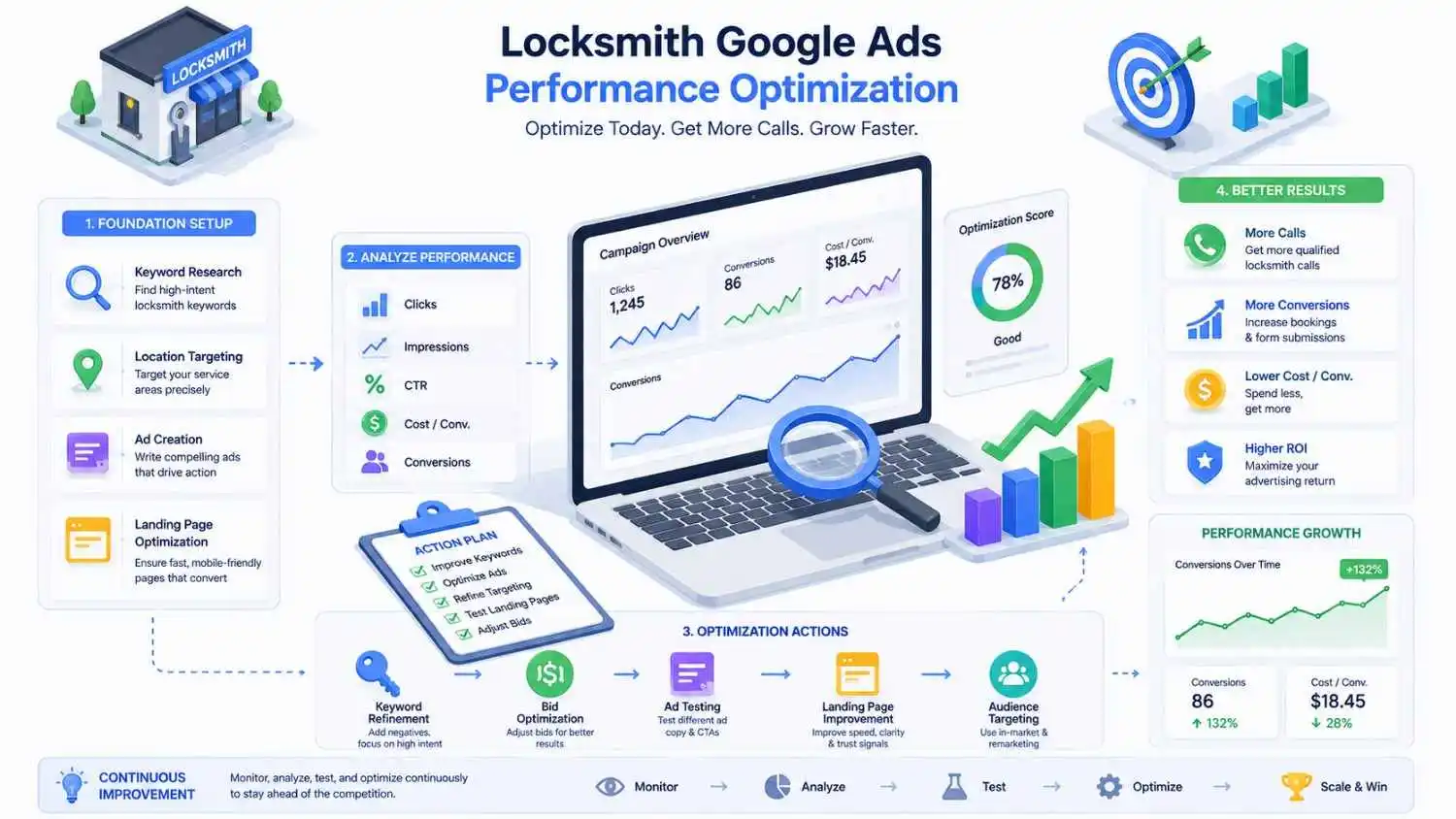
Locksmith Google Ads Performance Optimization
Performance optimization is an ongoing cycle, not a one-time project. This section covers the recurring checks that keep locksmith campaigns profitable long term.
Geographic Performance Optimization
Geographic optimization shifts budget toward the highest-converting service areas. Review performance by city and ZIP code monthly. Cut or lower bids in areas producing few qualified calls.
Device Performance Optimization
Device optimization adjusts bids between mobile, desktop, and tablet traffic. Most locksmith emergency searches happen on mobile phones. Bid up mobile traffic for emergency campaigns specifically.
Ad Schedule Optimization
Ad schedule optimization aligns spend with your real staffing and response capacity. Review call answer rates by hour of day. Cut ad spend during hours when calls consistently go unanswered.
Ad Copy Testing
Ad copy testing compares different headlines and offers to find top performers. Run at least two ad variations per ad group at all times. Replace losing ads regularly to keep improving click and call rates.
Bid and Budget Optimization
Bid and budget optimization redirects spend toward your best-performing campaigns. Review cost per booked job weekly, not just cost per click. Move budget from weak campaigns toward strong ones every month.
Lead Quality Feedback Loops
Lead quality feedback loops connect your dispatch team back to your ad account. Have dispatchers flag spam, wrong numbers, and low-quality calls. Feed that information back into your keyword and bid decisions regularly.
Google Ads Compliance and Advanced Verification for Locksmiths
Locksmiths must complete Google’s Advanced Verification program to run ads legally. This step exists because the locksmith industry has a history of scam operators. Skipping this step can get your entire account suspended.
Google Ads Advanced Verification Requirements
Advanced Verification requires proof that you are a real, licensed local business. Google requires this specifically for the locksmith category. Expect to submit business documents before your ads can run.
Business Identity and Verification
Business identity verification confirms your company name, address, and ownership. Submit accurate, matching business information across your website, ads, and Google Business Profile. Mismatched information can delay or block approval.
Licensing and Regulatory Information
Licensing information proves you meet your state’s locksmith regulations. Some states require specific locksmith licenses or bonds. Submit this documentation clearly during the verification process.
Accurate Business and Service Information
Accurate service information means your ads describe only what you actually offer. This problem happens when shops advertise services they do not actually perform. Keep your service list honest and specific to avoid policy violations.
Misleading Claims and Advertising Restrictions
Misleading claims can get your locksmith account suspended fast. Avoid vague promises like guaranteed lowest price without proof. Google actively enforces stricter rules on this category than most others.
Compliance for Locksmith Landing Pages and Ads
Compliance extends to your landing pages, not just your ads. Your landing page must show a real address, real license number, and real service area. This keeps you aligned with Google policy and builds real customer trust.
Key Takeaways
- Separate campaigns by emergency, automotive, residential, and commercial intent for better control.
- Emergency keywords deserve the highest bids and Call-Only ad formats.
- Negative keywords must expand weekly to stop wasted spend.
- Track booked jobs, not just calls, to measure true ROI.
- Complete Google’s Advanced Verification early to avoid account suspension.
Final Thoughts
Building Google Ads for Locksmith Leads that actually work takes more than picking a few keywords. It takes separated campaigns, tight geographic targeting, honest ad copy, and real call tracking tied back to booked revenue. Most wasted locksmith ad spend comes from skipping these steps, not from bad luck or bad markets.
We built Top7seven United States Performance Marketing Services to handle exactly this kind of work for local service businesses across the country. We manage the campaign structure, keyword strategy, tracking, and optimization so you can focus on dispatching real jobs. If you are ready to turn ad spend into booked locksmith work, we are ready to help.
Frequently Asked Questions
What keywords work best for Google Ads for Locksmith Leads?
The best keywords match real customer intent. Use terms like “emergency locksmith near me” and “car key replacement.” These phrases bring customers who need help fast.
What are negative keywords in a locksmith Google Ads campaign?
Negative keywords block unrelated searches. They stop clicks from job seekers or DIY searchers. Adding words like “jobs” or “how to” saves your budget for real customers.
How much does a locksmith cost per lead with Google Ads?
Cost per lead depends on your service type and city. Emergency and automotive keywords often cost more. Most locksmiths see leads range between $20 and $60 per call.
How do I improve conversions on Google Ads for Locksmith Leads?
You can improve conversions with fast landing pages and clear phone buttons. Track every call, not just clicks. Match your ad copy to what the customer searched for.
Is Google Ads worth it for locksmith businesses in 2026?
Yes, Google Ads works well for locksmiths in 2026. It reaches customers the moment they need help. Strong targeting and tracking turn ad spend into real booked jobs.